One of the very few traditions that is genuinely universal, or at least close to being so, is the harvest festival in agricultural societies, which makes perfect sense since for much of human history the difference between a good harvest and a bad one was the difference between a comfortable winter and a terrible one – and sometimes the difference between life and death.
What is rather less universal is how we go about it. Here in Britain, we sing songs and decorate churches, schools and sometimes even pubs. Germany plaits a crown out of wheat and carries it in procession to a harvest queen. America roasts a turkey, after pardoning one, and watches American football. Some of these traditions are ancient, while others are clearly recent, and some that feel ancient are actually decidedly new. So, let’s delve into the history of harvest festivals and the traditions that surround them, both here in the UK and around the world.

Before the Harvest Festival: Lammas, Harvest Home and the Neck
The earliest harvest festivals we have written records of come from Sumer and Egypt, around 2400 BC. But farming itself is some 7,000 years older than writing, so those records tell us less about when people started celebrating the harvest than about when they started keeping notes! The archaeology suggests it goes back a very long way indeed: at Raqefet Cave in northern Israel, a burial site occupied around 13,000 years ago, bedrock mortars show traces of wheat and barley that had been malted and deliberately fermented – the oldest beer in the world, probably brewed for ritual feasting by people who had not yet even invented farming.
Back in Britain, most of our oldest harvest customs were work rituals, carried out in the field by the people doing the reaping. The season opened at Lammas – from the Old English hlāfmæsse, “loaf mass” – a church service on 1st August when a loaf baked from the first ripe corn was blessed, but this was the beginning of harvest, not the end. It was followed by weeks of exhausting labour with hook and scythe, which ended in harvest home: a feast the farmer gave for his workers.
In Devon and Cornwall, they had “Crying the Neck.” When the last handful of standing corn was cut, a reaper would hold it above his head and shout, and the rest of the field would shout back. In Cornwall the “neck” was then plaited into a corn dolly, which presided over the feast of Guldize. The custom faded with the arrival of the combine harvester – it is difficult to cry the neck from inside a cab! – but was revived on a handful of Cornish farms after the Second World War.

A Victorian Invention
The traditional British Harvest Festival is held on the Sunday nearest the harvest moon, so late September or early October: produce on the altar, tinned goods, a marrow of absurd size and a great deal of singing. But it is hardly as old as many might assume. Credit for its invention usually goes to the Reverend Robert Stephen Hawker, who held a harvest festival in 1843 – though he wasn’t quite first. The Reverend Edwin Coleridge had been holding an annual one at Buckerell in Devon since 1840, decorated church and all.
On 13th September 1843, he put up a notice inviting his parishioners to gather in the chancel and receive, in the bread of the new corn, the sacrament ordained to strengthen and refresh their souls. The service was held on 1st October. The produce people brought was distributed to those in the parish who most needed it – which, in what came to be called the hungry forties, was a great many of them.
The idea spread over the years, helped along enormously by new harvest hymns. “Come, ye thankful people, come” was written the following year. “We plough the fields and scatter” arrived in 1861, translated by Jane Montgomery Campbell from a German original – so the most English-sounding harvest hymn in the book is in fact an import.

American Thanksgiving
You will see it claimed – including, we note, on a number of sites similarly purporting to explain the history of Thanksgiving – that the American holiday “began in Britain” with pagan harvest celebrations. This seems unlikely at best: harvest festivals are almost universal and no one has ever traced a line from British pagan custom to Plymouth. In any case, the modern British Harvest Festival is younger than the American Thanksgiving – if anyone borrowed anything, we rather suspect it was us.
So what actually happened? Probably little of what you’ve heard about the history of Thanksgiving is particularly accurate – but, fortunately, the reality is perhaps more interesting, if a little murkier.
Martin Frobisher's third expedition to the Arctic in 1578 was scattered by storms, and when the ships finally regrouped the chaplain, Robert Wolfall – a Somerset vicar appointed by the Queen's own Council – preached and gave communion, exhorting the men to be thankful for their strange and miraculous deliverance in so dangerous a place. It is often called the first Thanksgiving dinner, though it was, in truth, a church service. There are also claims for Champlain in New France in 1606, the Popham Colony in 1607, Jamestown 1607 and 1610, and Berkeley Hundred in Virginia, 1619 – and long before any of them, indigenous harvest observances across the continent. "First" is at best a contested title with at least six claimants!
For the Plymouth harvest gathering, we have two main sources: Edward Winslow and Governor William Bradford. Winslow wrote that, the harvest being gathered, four men were sent fowling and killed enough in a day to feed the company nearly a week; that the colonists exercised their arms; that many of the Wampanoag came, including Massasoit with some 90 men, who were entertained and feasted for three days; and that the Wampanoag went out and killed five deer and brought them to the plantation.
That is very nearly all we have in contemporary evidence. From it we can say what is not in the record: it was never called Thanksgiving by anyone present. There is no mention of an invitation – the Wampanoag may simply have arrived, as they had that spring. There were about 90 Wampanoag men to barely 50 surviving colonists, so the English were outnumbered roughly two to one. And the famous menu is largely a later invention: Winslow mentions only fowl and venison; Bradford, writing 20 years on, notes a great store of wild turkeys taken that autumn, so turkey may well have been there – though the idea of it as the fixed centrepiece is a modern one. Pumpkin was very probably on the table too, but not yet as pie: Plymouth probably lacked enough butter and wheat flour for a crust and had not yet built an oven. It was also, in all likelihood, a diplomatic occasion rather than a sentimental one – the colonists needed the alliance made that April to hold, and an arms drill in front of 90 guests was perhaps not entirely accidental.
Winslow's letter was rediscovered by an antiquarian named Alexander Young, who published it in 1841 – and gave it, in a footnote, the name it has carried ever since.

Becoming a National Holiday
Sarah Josepha Hale, editor of Godey's Lady's Book and the first woman to edit a major American magazine – and, incidentally, writer of “Mary Had a Little Lamb” – spent roughly 40 years campaigning for a single national day of thanksgiving, writing to governors, ministers, newspaper editors and successive presidents, most of whom ignored her. She also published the recipes: roast turkey, pumpkin pie – the menu America now considers ancestral was substantially shaped by a magazine editor. On 28th September 1863, she wrote to Lincoln. The proclamation followed just five days later, on 3rd October.
Even then, the date was not yet settled. November 1939 had five Thursdays, which made the traditional last Thursday fall on the 30th and left retailers fretting about a short Christmas season. Under pressure from them, President Franklin D. Roosevelt moved Thanksgiving to the fourth Thursday, a week earlier – but the country simply refused to agree, deriding the occasion as “Franksgiving.”
Thirty-two states followed the President, 16 did not, with Texas, Colorado and Mississippi hedging their bets by doing both. Newspapers printed “Democratic Thanksgiving” and “Republican Thanksgiving,” college football fixtures had to be rewritten, and the Three Stooges got a joke out of it, with Curly explaining that 4th July might well be in October: “You never can tell… look what they did to Thanksgiving!”
Congress finally settled it: the House voted for the last Thursday, the Senate amended it to the fourth Thursday to head off five-Thursday years, and Roosevelt signed on 26th December 1941. A Commerce Department survey afterwards found the whole exercise had produced no significant increase in sales whatsoever.
American Thanksgiving Traditions
The turkey pardon is routinely traced to Lincoln or Truman. Lincoln did spare a turkey, but a Christmas one, at his son Tad's request; the bird was called Jack. Truman spared none – the Truman Library has gone to the trouble of stating publicly that it can find no document, speech, clipping or photograph suggesting he ever did, and Truman told reporters in 1948 that his turkeys would come in handy. The first president recorded to have used the word “pardon” was Reagan in 1987, and he was making a joke to deflect questions about Iran-Contra: asked whether he would pardon Oliver North and John Poindexter, he gestured at the turkey. The annual ceremony only began with George H. W. Bush in 1989, who observed that the bird looked understandably nervous.
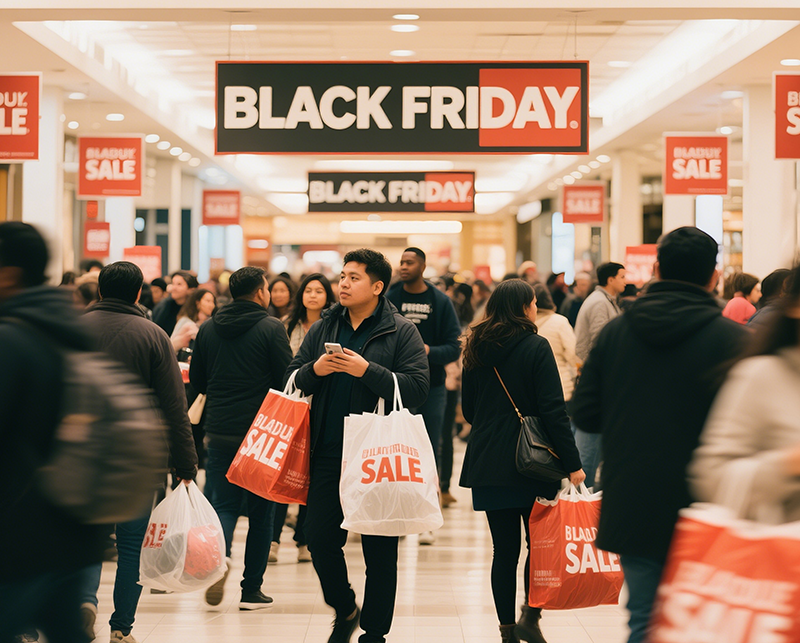
Black Friday is not named for shops moving from red ink into black. That explanation was invented by retailers, decades later; the real one is less flattering. The term came instead from Philadelphia police in the late 1950s and ‘60s, describing the Friday they all had to work: traffic jams, packed pavements, shoplifting and cancelled leave, compounded by the Army–Navy game in the city the next day. Local merchants, who hated the name, attempted to rebrand it “Big Friday” – and utterly failed.
Even so, Halloween in Britain is far from universal. A 2025 YouGov survey found that just over half of British adults didn’t celebrate it at all. It is growing, though, especially among the young, and the shops have certainly noticed: the fashion for Halloween trees and Christmas-style decorations even has a name, “Halloweenmas”.

Thanksgiving Around the World
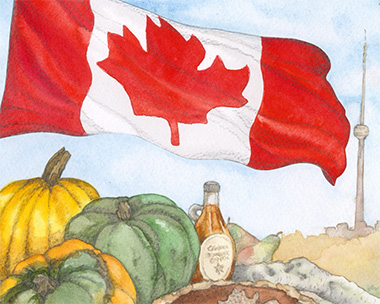
Canada fixed its Thanksgiving to the second Monday of October by Act of Parliament in 1957, having observed it annually since 1879 – though in the four Atlantic provinces it remains an optional holiday rather than a statutory one.
Germany, Austria and Switzerland keep Erntedankfest (Harvest Thanks Festival). It remains a rural, religious affair rather than a national feast and its great ornament is the Erntekrone (Harvest Crown) – a crown plaited from grain and dressed with flowers and fruit, carried in procession and presented to a harvest queen.
Japan marks Kinrō Kansha no Hi (Labour Thanksgiving Day) on 23rd November. It falls on the date of Niiname-sai (First Taste Celebration), the ancient imperial ritual in which the Emperor offers the first rice of the season and eats some himself. Though that ceremony continues, since 1948 the public holiday has honoured workers instead.
China's Mid-Autumn Festival falls on the fifteenth day of the eighth lunar month, so September or early October, and is marked with mooncakes, lanterns and family reunion. Korea's Chuseok almost empties the cities as people travel to their ancestral hometowns to make songpyeon (a small half-moon-shaped rice cake).
Thanks and Giving
The British Harvest Festival has quietly become one of the most useful days in the calendar. The produce on the altar is now largely tins, and it mostly goes to food banks – which is, when you think about it, exactly what Hawker was doing at Morwenstow in 1843, and for exactly the same reason.
Underneath all of it – the mooncakes, the corn dolly, the turkey, the plaited wheat crown – is a very simple and very old impulse: when one is fortunate, one should give thanks and should give to those less fortunate. So remember this seasonal sentiment as you send your cards this autumn, whether for the Harvest Festival or Thanksgiving, Erntedankfest or Kinrō Kansha no Hi – or even just a “thinking of you.”