As an English ecards company with fans all over the world, we often hear about differences in the way other countries celebrate the same holidays – and have to allow for that in our ecard designs. So this is the first in a series of articles exploring our way of doing things and how it differs from other national traditions. Since the contemporary incarnation of Valentine’s Day is a British creation (see below), this seems like the perfect place to start.
The Emergence of Valentine’s Day
Like your food during a romantic candlelit dinner, the origins of Valentine’s Day are a little unclear. In fact, once you dig deep into the history, you’ll encounter a tangle of half-truths, legends and, all too often, outright falsehoods repeated so often that they’ve become almost gospel.
So when – and how – did Valentine’s Day acquire its now-inseparable romantic theme? For that, we can likely thank (or blame) Geoffrey Chaucer and a few of his friends, who, around 1380, wrote a group of poems – possibly to celebrate the marriage of King Richard II and Anne of Bohemia – depicting Saint Valentine as the patron saint of mating birds and human lovers.
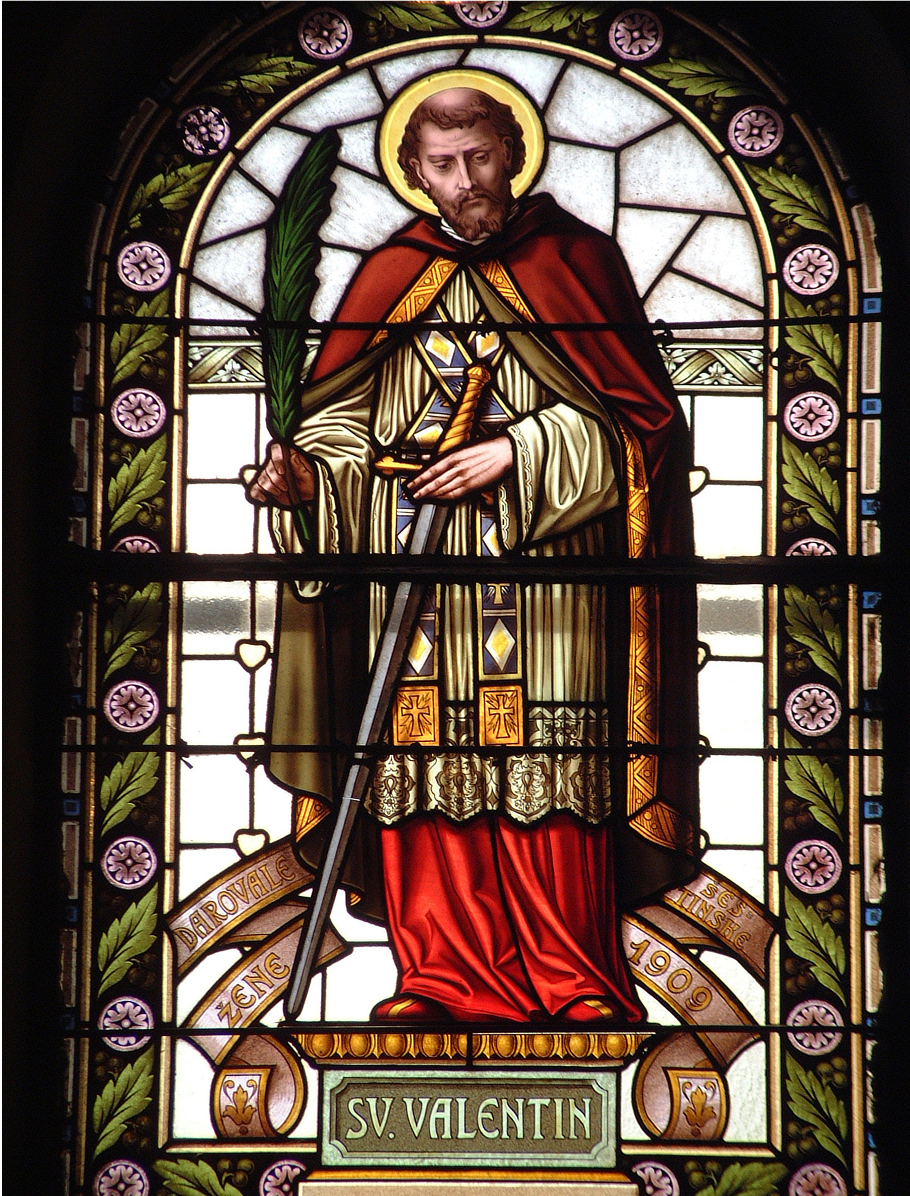
Who was Saint Valentine?
Nobody knows! We can make some guesses but, honestly, this is even murkier than the history – with even more fantasy. The Catholic Church’s official list of saints has several saints named Valentine, Valentinus, etc. – even a Valentina! – but only one whose feast day is 14th February: Valentino of Rome, martyred in 273 AD. Well, case closed, then? Maybe. This record first appears hundreds of years after Valentino’s purported death, and other writings about him tend not to quite line up as well as we’d like.
One such tale comes from 13th-century writer Jacobus de Voragine’s famous book “The Golden Legend”. There, he claims that Valentino, a priest, was summoned before Roman Emperor Claudius II himself. In the ensuing exchange, he almost succeeds in converting Claudius to Christianity but, at the last moment, is instead turned over to the prefect. While in custody, he prayed over his jailor’s blind daughter and her sight was restored, whereupon the whole household converted to Christianity. For his troubles, the emperor had him decapitated around 280 AD. You may have noticed that these dates don’t quite fit, with the official list of saints placing his death 7 years earlier – and I haven’t even mentioned that Claudius II died in 270 AD – but perhaps we can forgive Jacobus for this minor discrepancy, given that he was writing almost exactly a millennium after the supposed events!
Other tales have become part of the legend now as well – such as Valentine secretly marrying couples so the husbands could avoid conscription – but if there’s any semblance of romance and love attached to one of these stories, it was certainly written after Chaucer’s poetic influence had taken hold.
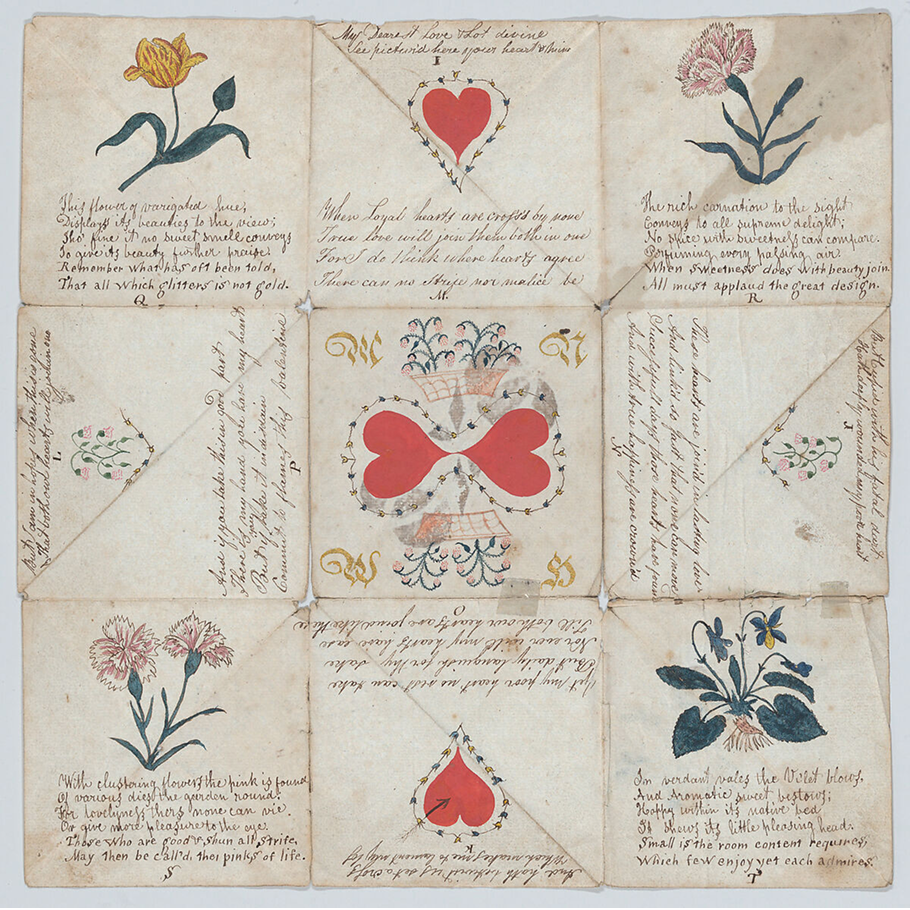
Letters, Lace and Love
By the 17th century, Valentine’s Day was firmly established as a romantic occasion. Lovers would exchange handwritten notes, often adorned with lace, ribbons and hearts, and sometimes accompanied by a small gift, like a handkerchief or some gloves. By the turn of the 19th century, a new form of correspondence had emerged: the puzzle purse. These thoughtful letters were intricately folded and ornately decorated so that each unfold revealed a new message or image – sometimes both. Frequently, the motifs were floral, allowing a new form of secret messaging to be used: floriography. Each flower could portray a different meaning depending on which it was, its colouring and even which other flowers were depicted alongside it. Clever, subtle and perfect for sneaky courtships!
But this practice did not last long. With the advent of the Industrial Revolution came improvements in printing, mass production and postage, leading to the decline of these beautiful creations and quickly turning Britain into a hub of card-sending, gift-giving Valentine’s Day mania.
Anonymous Valentines and the Uniform Penny Post
Two other great British inventions arrived in 1840: the adhesive postage stamp and the Uniform Penny Post. Prior to this, postage was paid by the recipient, who might well refuse a delivery if they didn’t recognise the sender. With the adhesive stamp came prepayment, allowing the postman to move on to the next delivery without having to wait for payment at each destination. This one logistical change made to improve the speed and efficiency of the postal service had a huge side effect: the possibility of anonymity.
Thus, the British tradition of anonymous Valentine’s Day cards was born. Originally a way to flirt discreetly without upsetting the famously strict courtship conventions of Victorian society, the practice of anonymously sending Valentine’s Day cards blossomed into a staple tradition – even so far as to become a common activity for young schoolchildren in recent times.
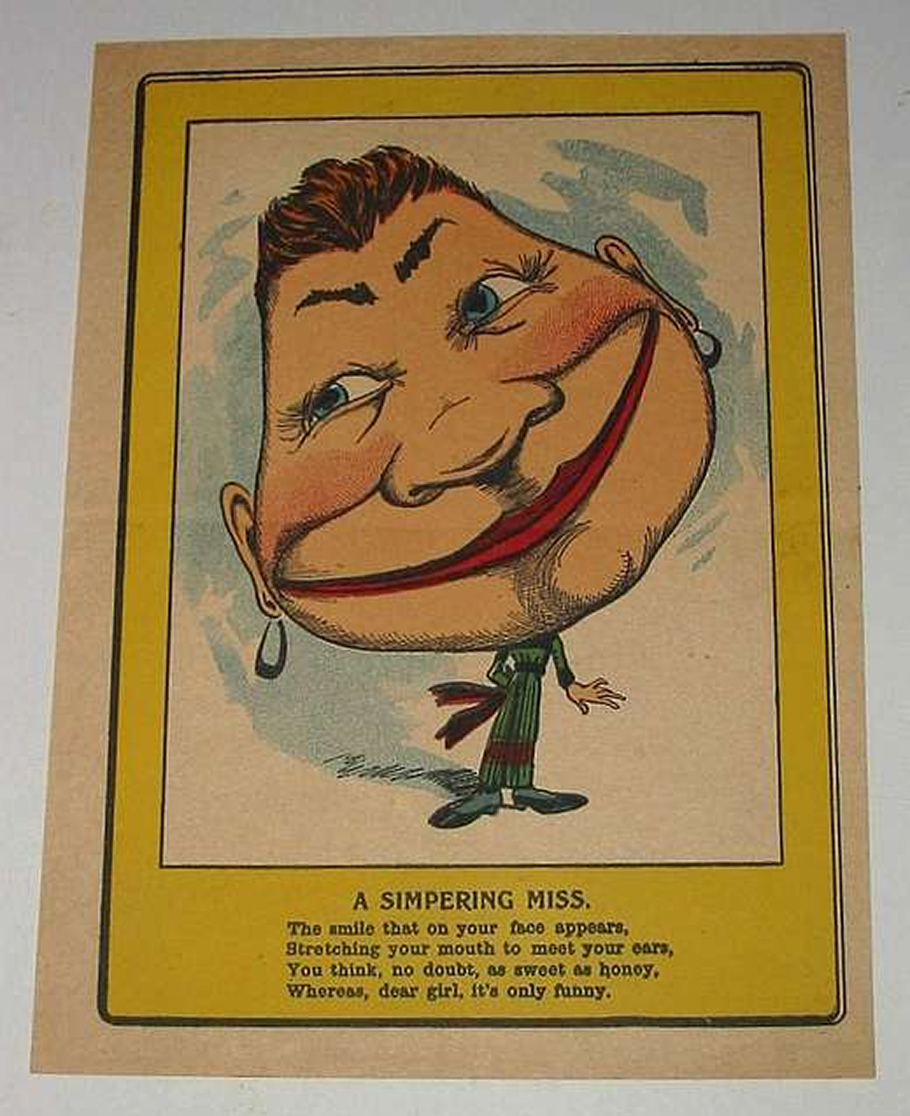
But alongside the newfound freedom to love came freedom to hate, all with the safety brought by anonymity – perhaps foreshadowing some of the wonders and horrors of the internet! – and “Mocking Valentines” were born. An import from America, where they were known as “Vinegar Valentines”, these cards presented the recipient with an offensive caricature intended to portray them and an accompanying verse highlighting their faults – often with exceptional cruelty – all under the guise of humour. Fortunately, by the end of the century, changes in social etiquette, which made open insults seem tacky rather than funny, and a shift towards a more sentimental and idealistic view of romance, meant that these vicious notes had fallen out of favour. It also probably didn’t hurt when manufacturers realised that offending potential customers wasn’t the best marketing strategy!

Masterstrokes of Marketing
It took a little longer for Valentine’s Day gifts to catch on, but in 1861, Cadbury’s (now Cadbury) produced one of the first heart-shaped boxes designed specifically for the occasion – and intended to be kept and used to store letters, keepsakes and other mementos. Their marketing was a stroke of genius.
In a culture that exalted the values of refinement, civility and decorum, chocolate was framed as an affectionate and respectable gift, in contrast to the undertones of passion and indulgence that afflicted many other luxury goods, such as alcohol. Flowers and jewellery also came to prominence and together they formed the triumvirate of treats that we still see today.
So, next time you’re handed a heart-shaped box of chocolates or a card adorned with roses, remember that behind all that sweetness lies a history of poetry, secret love affairs, postage reforms and some truly excellent marketing.

Into the Digital Age
With the arrival of the internet and e-mail, it was inevitable that someone, somewhere would eventually make an e-card. And so it was that in autumn of the year 2000, Jacquie Lawson sat down and created an animated Christmas card, “Christmas Cottage”, and emailed it to a few friends. Within weeks she was astonished to receive hundreds of replies from people all over the world, asking for more. So, on 10th February 2002, jacquielawson.com launched with just five cards, including, of course, a Valentine’s card: “Up to my Ears”. And the rest, as they say, is history!
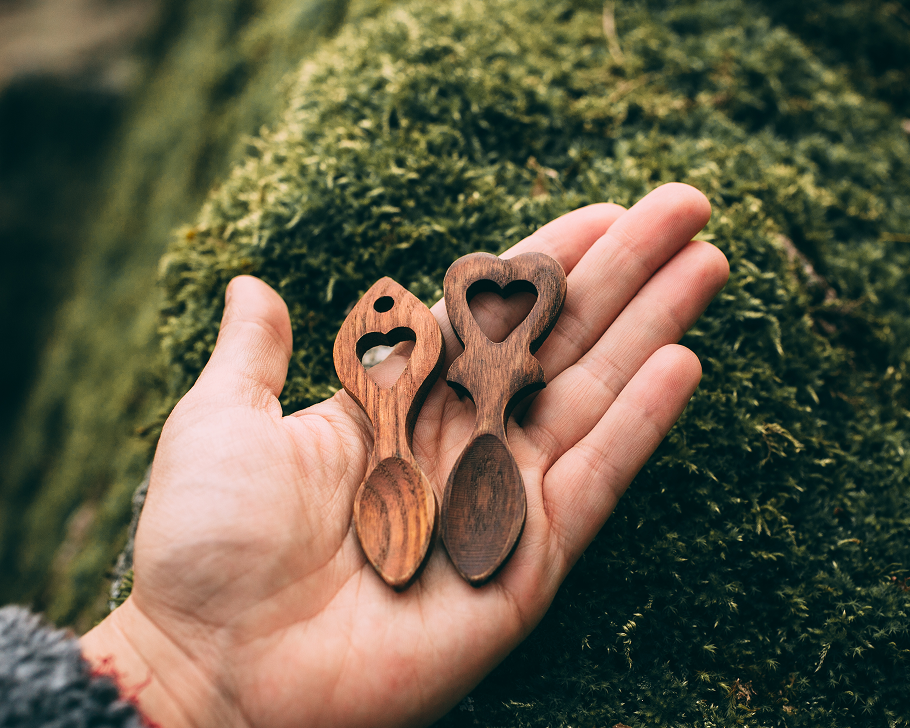
Lovespoons, Lotteries and Tricksters
While much of what you see in the general history of Valentine’s Day may not vary too much from today’s traditions, there were (and are) many weird and wonderful local customs – often far more playful, mysterious and fantastical.
In Wales, romance comes in the form of a spoon. These wooden “lovespoons” date back to at least the 17th century and are packed with symbolism: intricately hand-carved hearts to show love, knots for unity, horseshoes for luck, chains for commitment and keys to represent the keys to one’s heart or home. Even today, this wonderful tradition continues with lovespoons being made and presented at weddings and on Valentine’s Day.
In Scotland and parts of northern England, fate and chance took a prominent role. One popular tradition involved placing the names of young, unmarried people into a hat or bonnet. These names were then drawn at random, which would determine Valentine’s pairings. There were many variations on this: in some, the pairings lasted just for the day, in others they could last for an entire year; in some, only the men would draw names and in others both men and women would draw names, usually resulting in each person having two pairings – one whose name they had picked and one who had picked their name. Whatever the case, they would then flirt with, give gifts to and generally dote on the person whose name they had picked, with this sometimes developing into genuine romance. Occasionally, the names drawn would remain secret, adding a layer of intrigue in a manner similar to the contemporary “Secret Santa”.
In Norfolk there is another curious parallel to Christmas traditions: Jack Valentine. On Valentine’s Day morning, there would be a knock on the door but, when the door was opened, there would be nobody there – just some small gifts on the doorstep like sweets, small toys and chocolate. But sometimes, perhaps if the recipient hadn’t been good enough, there would be a lump of coal instead! Perhaps Jack, sometimes known as Old Father Valentine, is a friend of Father Christmas?
Around the World
Over the years, it has been quite fun to discover some of the traditions that our international audience have around Valentine’s Day. For instance, in most Portuguese-speaking countries, “Dia dos Namorados” refers to Valentine’s Day, yet in Brazil they instead celebrate Dia dos Namorados on 12th June, the day before Saint Anthony’s Day (another saint often associated with love).
But one of the strangest Valentine’s Day customs we’ve encountered came from a place we thought we’d know better: the United States! There, they send Valentine’s Day cards to anyone – brother, sister, mother, grandmother…
You can imagine our surprise when the requests for cards fit for that purpose came flooding in – after all, here in the UK, Valentine’s Day is about romantic love! This attitude has changed somewhat in recent times, most likely thanks to the influence of our transatlantic cousins, but most of us still hold Valentine’s Day to be primarily about the celebration of romantic love.